Translation or Exegesis? Which One to Start with to Understand the Quran?

Choosing Sources in Quranic Education: Discovering Layers of Meaning
One of the most common dilemmas faced by those new to Quranic learning in the Islamic world is the question, 'Should I read a translation (meal) or an exegesis (tafsir)?' This question is similar to the difference between knowing the basic structure of a building and knowing its architectural details and historical story. The Holy Quran has a multi-layered meaning structure, and both types of sources take on different roles in comprehending this structure. A correct source strategy ensures the reader avoids mental confusion and places their spiritual development on solid foundations.
Translation: The General Framework of the Divine Message
A translation (meal) is the transfer of Quranic verses into another language based on words or short sentences. The fundamental goal of the translation is to present the main lines and general framework of the divine message to a reader who is not proficient in the original language. For a believer at the beginning level, the translation is the first stop for the question 'What does our Lord command in general?' However, the fact that every translation is not a direct translatio but a 'transfer of meaning' must not be ignored. Instead of getting stuck on a single translation, comparing different ones allows you to catch the richness of meaning that might be lost due to linguistic boundaries. The balance between literal and spiritual translations expands the reader's perspective.
Exegesis: In-Depth Analysis and the Search for Wisdom
Exegesis (tafsir), on the other hand, consists of comprehensive works that explain the reasons for revelation (asbab al-nuzul), linguistic subtleties, jurisprudential rulings, and links with other verses from a broad perspective. If you have in-depth and analytical questions in your mind like 'What is the actual intent in this verse?' or 'How does this ruling reflect on today?' then the tafsir corpus is where you must apply. Tafsir steps in where the translation remains limited by words, illuminating the historical and universal background of the revealed truth. Attempting to understand particularly complex ruling verses without the guidance of scholars can lead to serious errors in interpretation. Knowledge of methodology (usul) is the greatest gain from tafsir readings.
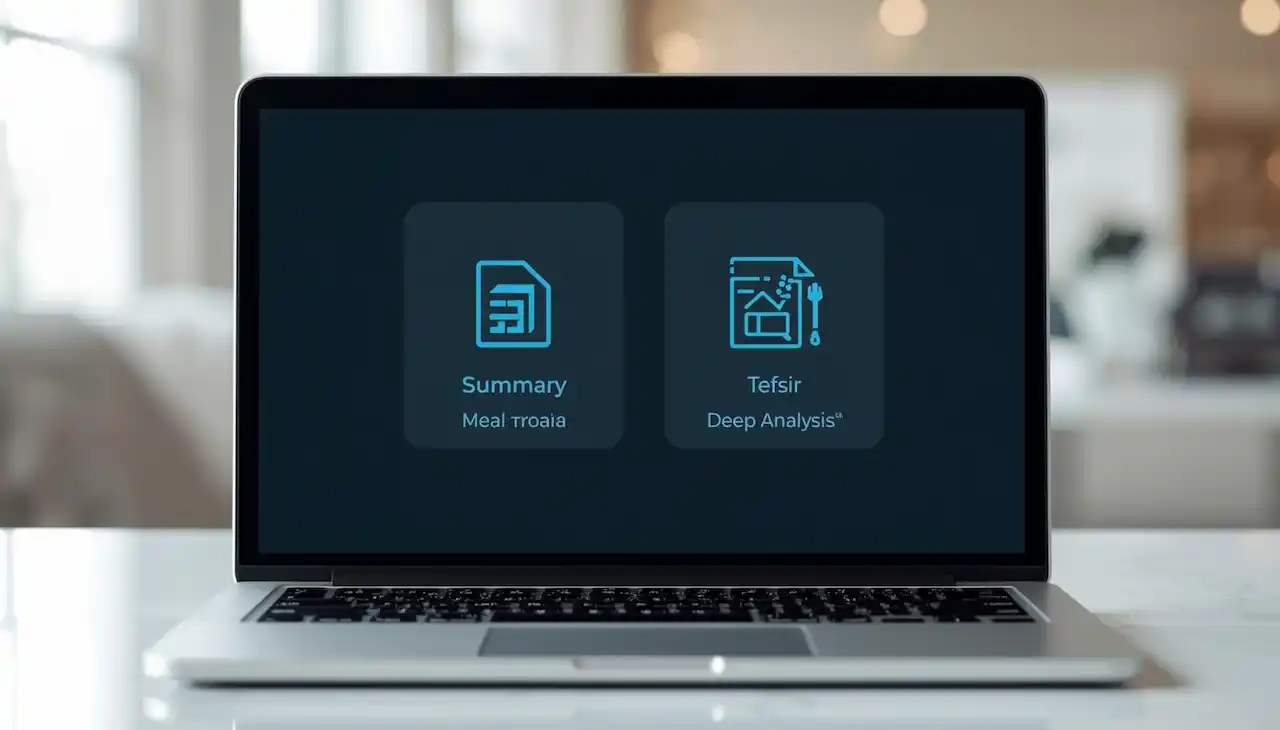
Needs-Oriented Learning Model
For beginners, the most efficient method is to follow a step-by-step and synthetic path. Directly diving into thousands of pages of heavy tafsir sets can cause a loss of motivation after a while. The recommended methodology is first to read the translation of the verses to grasp the general message, then to conduct specific tafsir research for verses that create question marks in the mind or arouse curiosity in the heart. This 'needs-oriented learning' model ensures that information is much more permanent in the memory. Curiosity is the greatest engine of knowledge, and digital libraries supporting this method reduce the research process to seconds. Gradual education is essential for long-term spiritual discipline.
Semantic Depth and the Boundaries of Language
Differences in expression between translations often cause confusion among readers. However, this situation stems from the semantic depth of the Arabic language and the polysemy (multi-meaning) characteristic of words. While some translations follow a 'literal' path, others prefer a 'spiritual' (meaning-oriented) style. These differences are not contradictions but a richness. Conducting academic comparison is an intellectual exercise that allows us to see how many truths the Quran can point to with a single verse. What is fundamental is the unchanging original text of the Quran; translations are our efforts to approach that text.
Authentic Knowledge and Consciousness Transformation
Another point to consider in text readings is the strength of the link established between current issues and the verses. Reading tafsir provides the reader with a 'methodology.' Thanks to this methodology, a person learns to evaluate verses not according to their own arbitrary interpretations, but in the light of the fundamental constants of Islam. Turning to authentic knowledge sources is the greatest armor against the dangers of disinformation and misinterpretation brought by the modern age. Ultimately, translation and exegesis are not alternatives to each other but complements. The translation opens the door, and through exegesis, one enters that door to discover the rooms. The true goal is for every line read to add value to a person's character, morality, and worldview. An increase in knowledge must bring along a consciousness transformation.

Quran and Its Translation — Experience This Now
Download our app to explore all these features and more.