Optics and Mirrors: Don't Be Intimidated, Grasp the Logic
The Nature of Light: Geometric Secrets of the Optical World
Optics is one of the most voluminous, visual, and perhaps most technical units of the TYT and AYT physics curriculum. Combining both the particle and wave nature of light, this field covers a wide range from mirrors to lenses, from refraction to colors. The reason many students shy away from optics is the perception that there are too many ray drawings and rules. Yet, optics is actually the geometry of light. The way light hits a surface and reflects, or refracts while changing environments, is a dance performed within the framework of specific physical laws. The secret to success in this unit is developing a 'ray drawing reflex' and grasping the logic of image formation instead of rote memorization.
Laws of Reflection and Plane Mirrors
Reflection, the bouncing back of light from a smooth surface, is the most fundamental law of optics. The fact that the incident ray, reflected ray, and normal are in the same plane, and the rule that 'the angle of incidence equals the angle of reflection,' is an unshakeable principle valid for all mirror types. Questions built on the properties of images formed in plane mirrors (virtual, upright, symmetrical, and equidistant to the mirror) generally test spatial perception. In dynamic scenarios like rotating the mirror or the movement of the observer, the technique of 'looking from behind the mirror' is an academic tactic that saves time during exams.
Spherical Mirrors: The Character of Concave and Convex Mirrors
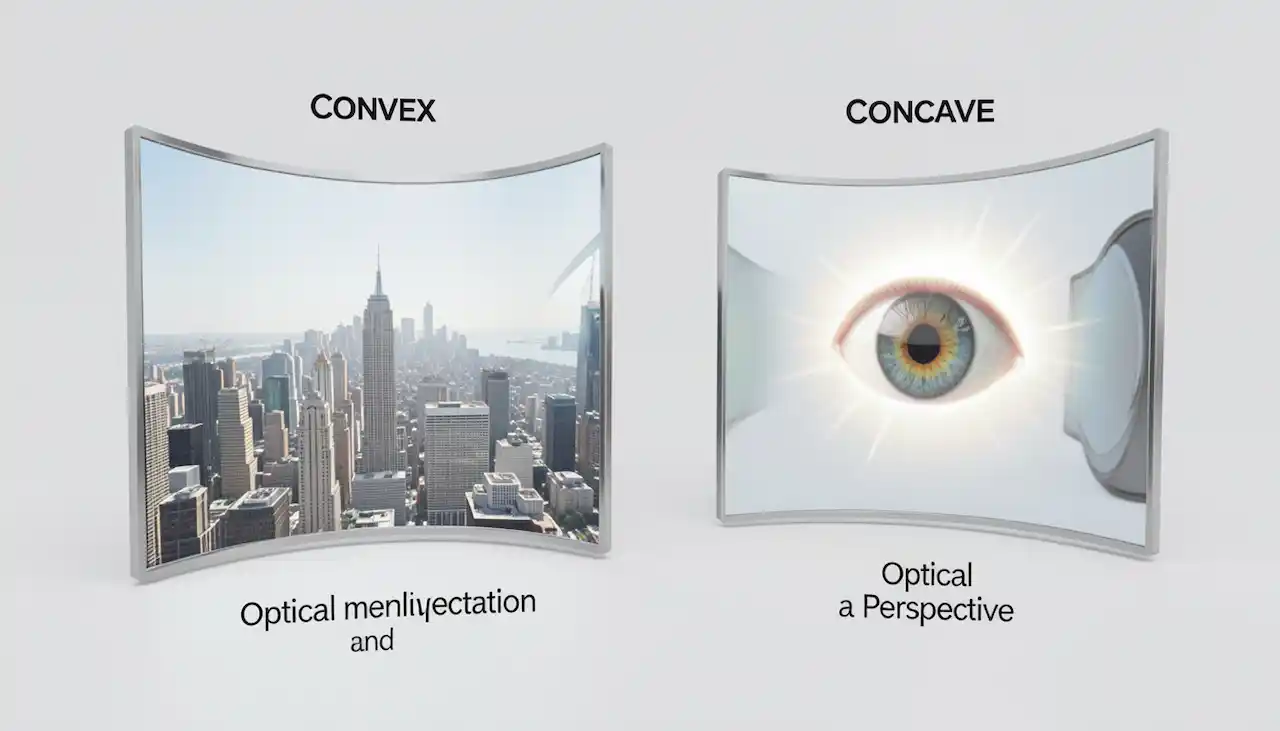
Spherical mirrors are the most technical part of optics due to their ability to collect light at a point (concave) or scatter it (convex). Knowing the properties of special points like the focal point ($f$), center ($C$), and vertex ($V$) is enough to determine the route of the rays. The fact that the image in concave mirrors can be giant (macroscopic) or dwarf (microscopic) depending on the object's position explains why these mirrors are so widely used, from dentist mirrors to telescopes. Convex mirrors, on the other hand, always provide a 'reduced and virtual' image, offering a wide field of view. Saving this information as a visual simulation rather than a table minimizes the margin of error.
Refraction of Light and Snell's Law
Refraction, the change in direction and speed of light as it passes from one transparent medium to another, is one of the most vital topics in optics. The difference between the indices of the media determines the degree to which light approaches or moves away from the normal. Snell's Law ($n_1 \cdot \sin\theta_1 = n_2 \cdot \sin\theta_2$) is the mathematical expression of this change. While studying refraction, you must never forget that the speed of light is inversely proportional to the refractive index of the medium it passes through ($v = c/n$). Many natural phenomena, from mirages to the formation of rainbows, are a result of this property of light changing direction through refraction. In the exam, this unit is usually asked in combination with lenses.
Mercekes: The Art of Bending Light and Eye Defects
Converging (convex) and diverging (concave) lenses are systems where light undergoes refraction twice. The working logic of lenses is actually to combine the refractive effects of two spherical surfaces. The ability of converging lenses to form real images places them at the heart of cameras and the human eye. Diverging lenses always produce a virtual and small image. Relating the academic knowledge in this section to eye defects (Myopia, Hyperopia) and which lenses correct these defects allows you to build links with medicine and biology. Mnemonic codes like 'Hypermetropia likes it thin' (farsightedness is corrected with a thin-edged/converging lens) prevent confusion during the exam.
Colors and Light Theory: The Dance of Wavelengths
The final section of optics, colors, is a reflection of light's wave nature. Grasping the logic of primary colors (Red, Green, Blue) and the secondary colors formed by their mixtures explains why objects appear in different colors. The fact that an object appears only in the color it reflects and that black absorbs all colors is also related to the heat and temperature unit. Distinguishing between light filters and paint colors (Yellow, Magenta, Cyan) is the key, especially for verbal-logic questions. While studying colors, knowing the wavelength order in the electromagnetic spectrum is an academic necessity.
Prisms and Total Internal Reflection: Optical Foundations of Technology
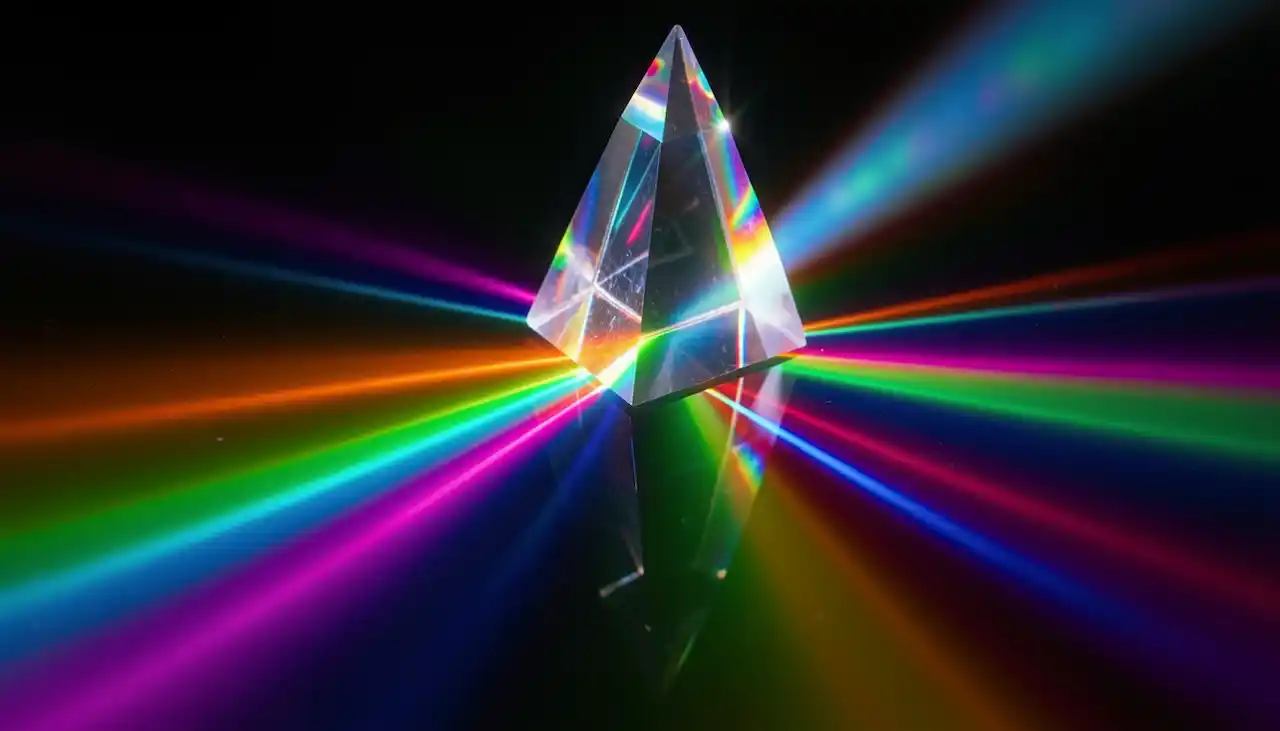
The separation of light into its colors while passing through prisms and the phenomenon of total internal reflection occurring in fiber optic cables are the basis of modern communication technology. Knowing the concept of the critical angle and the conditions under which total internal reflection occurs (passing from a high-density to a low-density medium) puts you ahead in technical questions. The ability of prisms to deviate light by 90 or 180 degrees forms the working principle of many optical devices, from periscopes to binoculars. Recognizing optical devices is about transforming theoretical knowledge into engineering practice. Total internal reflection is the hidden hero of modern internet speeds.
Conclusion: A New Perspective on the World Through Optics
In conclusion, the optics unit is not just an exam subject, but the science of the mechanisms that allow us to see the world around us. Drawing plenty of diagrams, following rays like lasers, and questioning the logic of events is the only way to success. Optics is where geometry marries physics; a student who knows the rules of this marriage will solve even the most complex shapes in the exam like a puzzle. A process supported by regular question solving and concept maps is one of the most solid steps that will lead you to total success in physics. Follow the path of light; it will lead you to success.

TYT AYT Physics: Topics & Formulas — Experience This Now
Download our app to explore all these features and more.