English Daily Life Object Names: Lexical Environment and Concrete Concepts

Object Names Guide: The Power of Concrete Concepts in Language Acquisition
In the journey of learning English, object names are the concrete data points that serve as the foundation of the linguistic structure. While abstract grammar rules can be fleeting in the mind, naming objects with physical counterparts in the real world allows the brain to forge an unbreakable bond between the 'visual cortex' and the 'language center.' Academic linguistic research indicates that when individuals begin naming the objects in their immediate environment in the target language, their sense of foreignness toward that language decreases by 40%. In this guide, we delve deep into the English equivalents of essential objects we interact with daily—from home to the workplace—and how these words construct a 'semantic map' in the mind.
The Home Environment: Thinking Your Living Spaces in English
The home, where an individual spends the most time, is effectively a living vocabulary laboratory. Naming the sub-objects within main sections like 'kitchen,' 'living room,' and 'bedroom' marks the beginning of the language immersion process. Coding the refrigerator as 'fridge'—not as a translated word, but as a functional object where food is preserved—allows the brain to think in a translation-free manner. Micro-objects like 'spoon,' 'fork,' and 'plate' in the kitchen integrate English naturally into the daily routine. This process develops a reflex that makes the word flash in the mind the very moment you see the object.
School and Educational Supplies: Nouns of the Academic Alphabet
Objects at the center of educational life are the linguistic reflections of cognitive processes. Words like 'notebook,' 'pencil,' and 'desk' are not just items; they are symbols of the act of learning. Adding complementary items such as 'ruler' or 'backpack' while learning these words facilitates recall through the 'chunking' technique. Mastering the object names used in an academic setting removes lexical barriers that prevent a student from focusing on the lesson content. Object names are the most fundamental and tangible building blocks of academic success.
Business World and Office Technologies: Classifying the Professional Environment
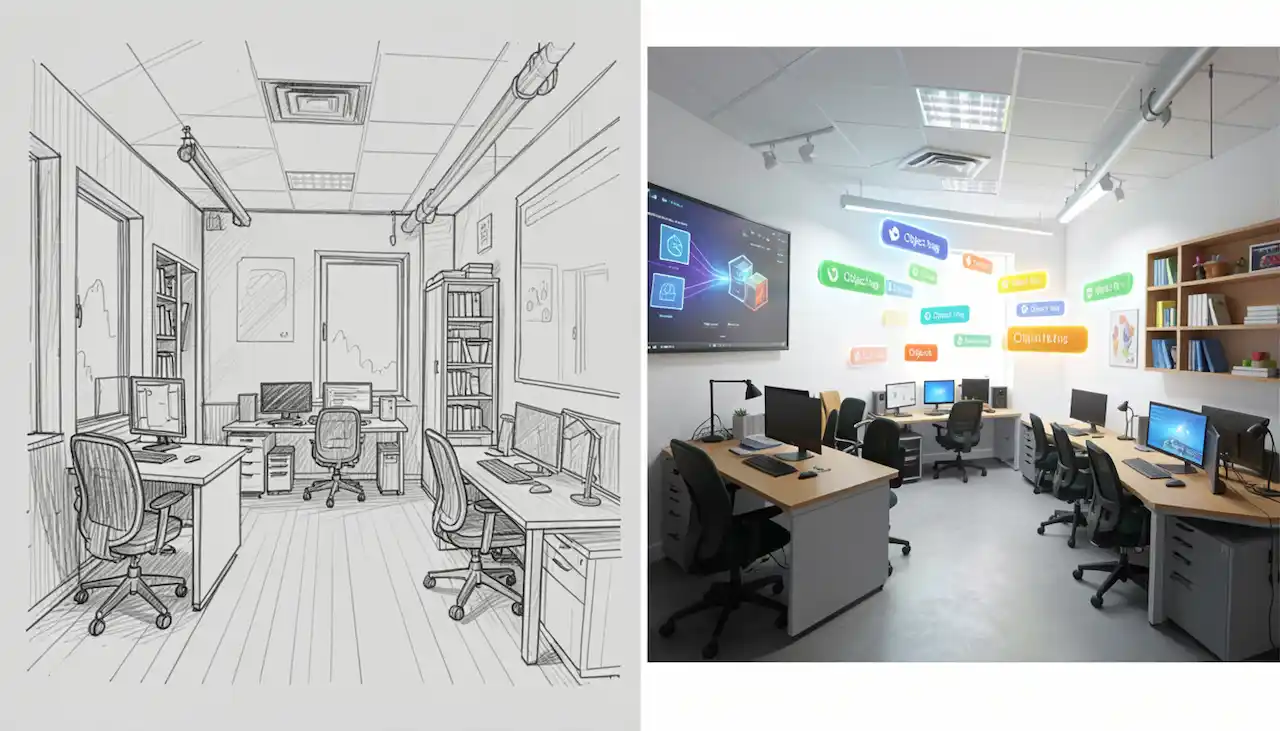
Modern professional life is shaped around technological objects and professional equipment. Words like 'laptop,' 'printer,' 'keyboard,' and 'screen' are the universal instruments of the global language of work. Knowing the names of these objects grants an individual professional dignity when explaining a technical issue or coordinating a workflow. Auxiliary tools in the office environment, such as 'folder,' 'stapler,' and 'whiteboard,' are the micro-coordinates of workplace communication. Professional environment literacy is one of the most important indicators reflecting a person's competence in the language.
Semantic Association: Learning Objects Through Their Functions
Instead of memorizing words in dry lists, learning objects alongside the actions they perform (verbs) is academically the most effective method. For example, pairing the word 'chair' with the verb 'sit,' or the word 'lamp' with the concept of 'light,' opens a bidirectional neural pathway in the brain. This semantic association ensures that even if an object's name is forgotten during a conversation, the mind can retrieve that word through its function. Objects are the stages for actions in language; those who recognize the stage can manage the script more comfortably.
Visual Memory and Spatial Labeling Techniques
The brain stores visual data much faster and more permanently than textual data. Applying the 'spatial labeling' technique when learning object names yields revolutionary results. Sticking small cards with names on household items ensures that the information is passively repeated every time the eye encounters that object. This use of iconic memory removes the necessity for rote memorization, turning learning into a process of 'recognition.' After a while, even when the cards are removed, the mind will automatically project the English label onto the object upon seeing it.
Polysemy and the Different Faces of Objects
In English, some object names can acquire entirely different meanings depending on the context. For instance, the word 'pen' can mean both a writing instrument and an enclosure for animals, or 'glass' can refer to both the material and a drinking vessel. Learning such cases of polysemy through objects is critical for grasping the flexibility of the language. An academic study should cover not only the most common meaning of an object but also its secondary meanings in daily language. This depth allows the speaker to develop a richer and more accurate rhetoric. Objects are the multi-dimensional mirrors of language.
Conclusion: From the Physical World to Linguistic Freedom
In conclusion, mastering daily life object names is akin to swimming near the shore without drowning in the vast ocean of English. You master a language to the extent that you can name your surroundings. Be patient, incorporate five new objects into your world every day, and keep them alive within sentences. Remember that learning a language is to rediscover the world; objects are your most loyal guides on this journey of discovery. Now, lift your head and look around; everything you see is waiting to whisper something to you in English.

English Object Names: Visual & Audio Vocabulary Builder — Experience This Now
Download our app to explore all these features and more.