Concepts of Ibadat and Muamalat in Fiqh: Differences and Balance

Two Main Branches of Islamic Law: The Dialectic of Ibadat and Muamalat
Islamic Fiqh is divided into two main categories to better manage its wide scope and to better convey the logic of the rulings: Ibadat and Muamalat. Ibadat represents the direct relationship between the servant and the Creator—namely, the noble duties to be fulfilled toward Allah—while Muamalat regulates the legal, social, and economic relations between people. These two concepts complement each other like two sides of a coin. A Muslim individual's life is built upon the Fiqh balance between these two areas. When one is missing, the integrity of religious life is damaged and its representative capacity weakens.
The Immutability of Worship: The Principle of Tawqifiyyah
In the field of Ibadat, the basic rule is 'tawqifiyyah.' This means that how a worship is performed, its times, and its pillars are directly determined by revelation and cannot be changed by reasoning or according to the fashion of the times. The number of rak'ahs in prayer, the places of Hajj, or the time of fasting are examples of this. The aim here is for the servant to demonstrate their devotion and submission to Allah in a pure form. The essentials of worship do not change form according to changing time and place; they are universal and fixed. This stability is the most important protective shield of Islam’s common identity, unity, and oneness. In Ibadat, 'bid'ah' (innovation) is rejected.
The Dynamism of Muamalat: Ibaha and Maslahah
Muamalat, contrary to worship, has a much more dynamic structure. Here, the basic rule is the principle of 'The original state of things is permissibility (ibaha),' meaning that everything is permissible unless there is evidence to the contrary. Topics such as trade, rent, incorporation, and family law between people are examined under the heading of Muamalat. Most rulings in Muamalat are based on a 'cause' (illah) or a wisdom. Therefore, as the needs of societies change, Fiqh produces new solutions without breaking away from basic principles. Islamic law, thanks to this flexibility in the field of Muamalat, has shown the ability to be applied in different geographies for centuries. Change is within the principle itself.
The Function of Intention: The Difference Between Action and Law
One of the biggest differences between Ibadat and Muamalat is the issue of 'intention.' For an action to be considered worship, a sincere intention solely for the sake of Allah is a condition. In Muamalat, while intention is important from a moral point of view, fulfilling external conditions and rules is sufficient for legal validity. For example, if a person stands on a prayer mat without sincere intention, their worship is spiritually invalid; however, a person who makes a contract according to the procedure has a legally valid contract even if they harbor worldly greed at that moment. Yet, for a believer, honesty in Muamalat is a moral necessity that nourishes the soul of worship and elevates it to the heavens.
Vertical and Horizontal Connection: Human Rights and Divine Rights
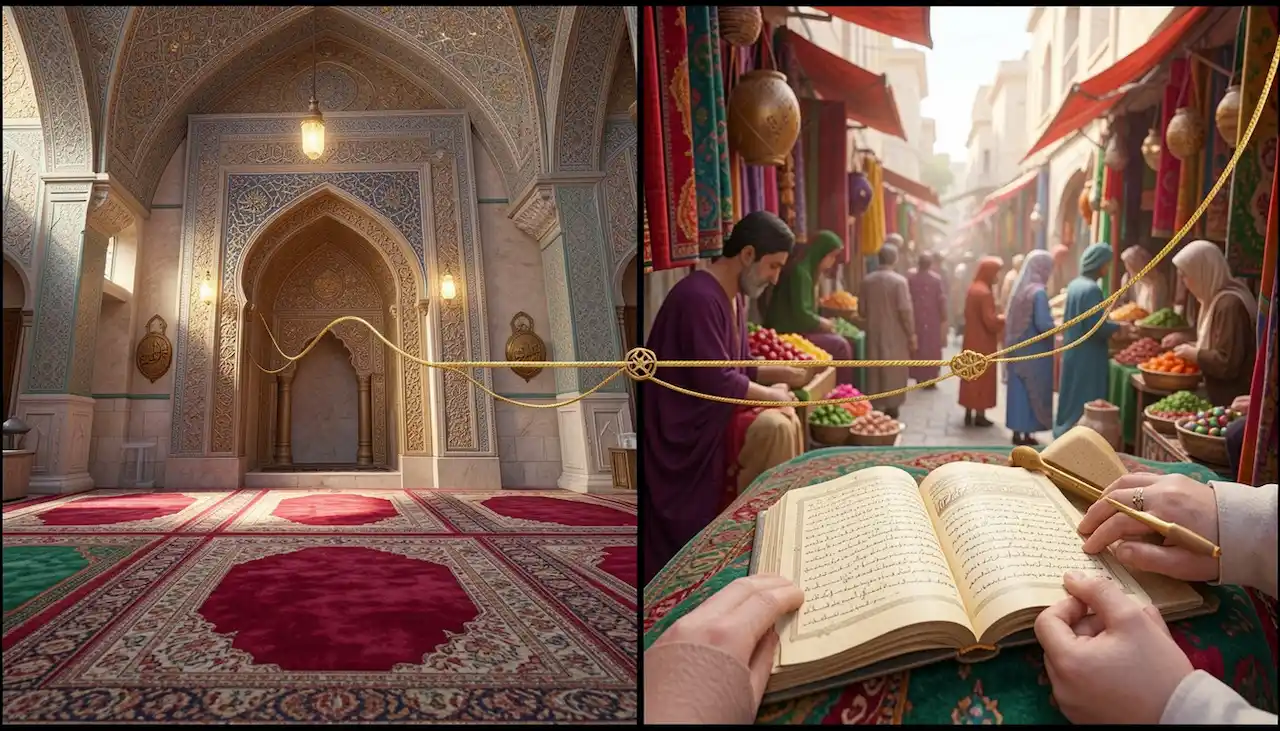
How these two areas affect each other is one of the most vital points of Islamic ethics. Ibadat represents the right of Allah (Huququllah), while Muamalat represents more the rights of servants (Huququ'l-Ibad). It is not possible for someone who violates the rights of others to get the spiritual pleasure they expect from their worship. The forbidden acts in Muamalat extinguish the light of worship. Likewise, a worship performed rightfully should restrain the person from bad behavior and unfair treatment. The science of Fiqh does not see these two areas as disconnected compartments; on the contrary, one is the validation of the other. Correct Muamalat is the natural fruit of an honest life of worship.
Specialization in Knowledge and Application in Life
While learning the Fiqh of worship is an individual necessity, deepening one's knowledge in the Fiqh of Muamalat is a social duty. Someone engaged in trade must know trade law, and someone about to marry must know family law. Ignorance is not an excuse. Fiqh depth is the ability to live in both areas without conflicting them, giving each the weight it deserves. Today, specializing in areas such as financial Fiqh or medical Fiqh will determine the quality of the answers Islamic civilization will give to current questions. Knowledge must permeate every square inch of life.
Conclusion: The Formula for Happiness in Both Worlds
In conclusion, grasping these two main branches of Fiqh means understanding Islam's perspective on life holistically. We pay our debt to Allah through worship and our responsibility to people through honest Muamalat. A religious life that flies with these two wings both brings inner peace to the individual and lays the unshakeable foundations of a just society. True religiosity is being able to combine sincerity on the prayer mat with honesty in the marketplace. This Fiqh vision removes the Muslim from being a passive believer and turns them into an active subject who builds justice and beauty on earth.

Fıkh Encyclopedia & Islamic Law Guide — Experience This Now
Download our app to explore all these features and more.