AYT Mechanics: Master Motion, Force, and Energy at an Academic Level

Mechanics: Understanding the Laws of Motion of the Universe
The mechanics unit constitutes approximately 40%-50% of the physics course in AYT, the second stage of the University Entrance Exams. Mechanics is the most established branch of physics, examining the motions of macro-level objects, the causes of these motions (force), and the energy changes occurring during motion. AYT Mechanics, unlike TYT, requires deeper mathematical analysis, vectorial operations, and complex system modeling. The way to be successful in this unit is not just to pour formulas onto paper, but to be able to apply that unshakeable bond between force and acceleration (Newton's 2nd Law) to any scenario. Mechanics is the gateway to the engineering discipline.
Vectors and Relative Motion: A Matter of Perspective
The language of mechanics is vectors. Not only the magnitudes of quantities like force, velocity, acceleration, and displacement, but also their directions and orientations determine the fate of calculations. Breaking vectors into components and the tip-to-tail addition methods are the fundamental tools for all mechanics questions. Relative Motion, on the other hand, analyzes how velocity changes according to the observer's state. In classic questions like river problems, clarifying the distinction between velocity relative to the ground and velocity relative to the water is critical for grasping the logic of vectorial summation. Motion is always defined relative to a reference system; a student who chooses the reference system correctly has already solved half the problem.
Newton's Laws of Motion and Friction Dynamics
The three fundamental laws of Newtonian mechanics are the constitution of AYT physics. Inertia, the fundamental principle ($F=m \cdot a$) and the action-reaction principles appear everywhere, from the simplest block questions to the most complex inclined plane problems. Here, especially understanding the difference between the static and kinetic states of friction force is the key to selective questions. The graphical transition between static friction, which resists the applied force until the object moves, and kinetic friction, which kicks in while in motion, must be meticulously examined at an academic level. Drawing force diagrams (Free Body Diagrams) is the most guaranteed way to find a solution.
Projectiles and Motion Analysis Under Gravity
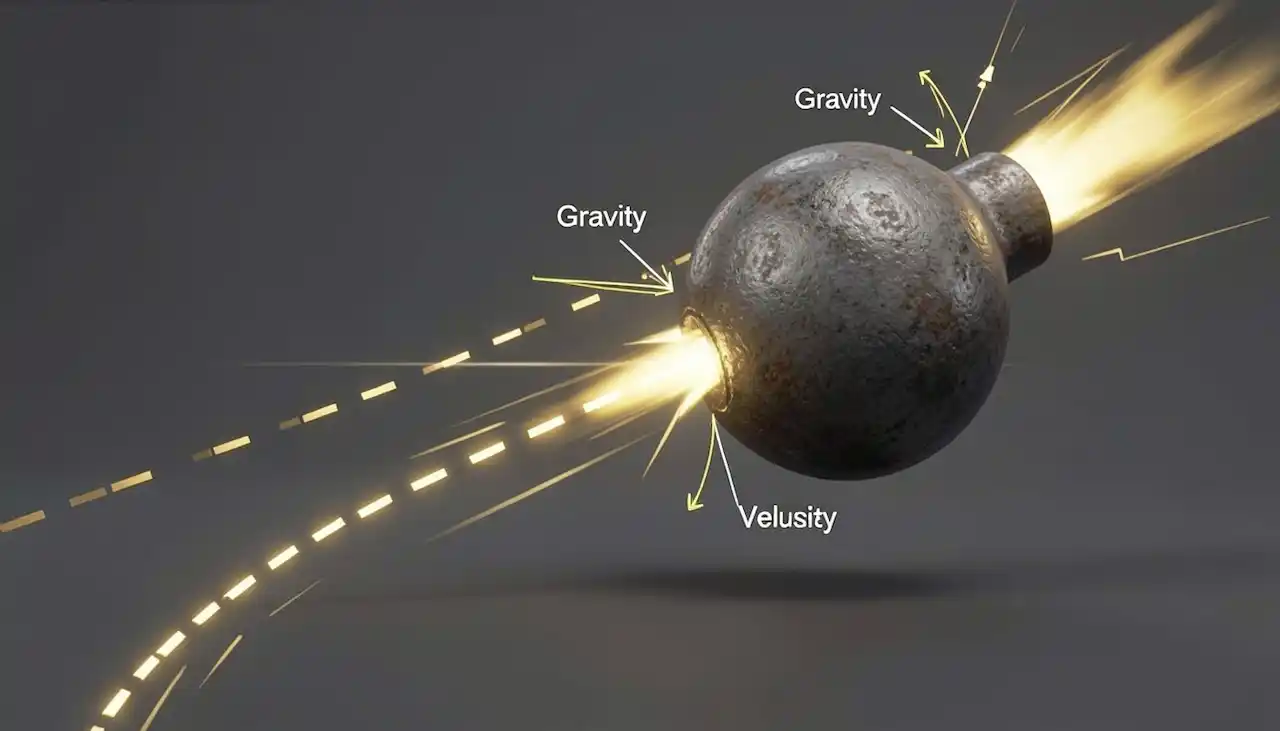
Motion in one dimension (free fall, vertical launch) and in two dimensions (horizontal and projectile motion) examines ideal systems where gravitational acceleration ($g$) is constant. While studying projectiles, it's necessary to embed into the mind that the horizontal component of velocity does not change in a frictionless environment, while the vertical component increases or decreases by $g$ every second. Blending projectile formulas with the principle of conservation of energy allows you to calculate complex 'maximum height' or 'range' values much faster. Projectiles are the most concrete application area of the magnificent balance between kinematics and energy.
Work, Power, and Energy: Treasures with Conservation
The work-energy theorem is one of the most powerful problem-solving tools in physics. The fact that a force must have a component in the direction of displacement to do work is the foundation of energy transformations. Transitions between potential energy (gravitational and elastic) and kinetic energy are analyzed with the law of 'conservation of energy' in all kinds of systems, whether with or without friction. Power, as work done per unit time, measures the efficiency of motors and systems. In energy questions, setting up the 'initial energy equals final energy' equation is the shortest academic method that will save you from struggling with complex equations of motion.
Impulse and Linear Momentum: The Physics of Collisions
Momentum ($P=m \cdot v$), heightens the amount of motion as a vectorial quantity. As long as no net external force acts, the conservation of the system's total momentum (Conservation of Momentum) is the only way to solve collision and explosion questions. Distinguishing between the energy and momentum balances in elastic and inelastic collisions determines your success in this section. Impulse, meanwhile, is the change in momentum and is calculated by the area under force-time graphs. Many modern technologies, from airbag systems to rocket propulsion, were born from this relationship between impulse and momentum.
Torque and Equilibrium: Analysis of Static Systems
Not only the translation of objects but also their rotational effects are the subject of mechanics. Torque, the rotational effect of force, and the conditions for systems to remain in equilibrium (Net Force=0, Net Torque=0) are used in every field from civil engineering to biomechanics. Knowing the differences between center of gravity and center of mass, and being able to establish torque equilibrium relative to a pivot point, allows you to solve the 'rod and weight' questions in the exam without error. Simple machines (lever, pulley, inclined plane) are the most basic mechanical tools where torque and work principles are used to increase human power. Learning the concept of efficiency through simple machines reinforces the numerical logic of AYT.
Conclusion: Mechanics Discipline and Engineering Vision
In conclusion, AYT Mechanics requires patient analysis and a strong mathematical foundation. When you adopt the topics not as disconnected formula lists but as laws of nature, you will realize how orderly seemingly difficult problems actually are. Make it a habit in every study session to draw free body diagrams, decompose vectors, and conserve energy. A student who masters mechanics will have laid an unshakeable foundation not only for AYT physics but also for technical courses in university life. Now feel the force, manage the energy, and accelerate toward your goal.
TYT AYT Physics: Topics & Formulas — Experience This Now
Download our app to explore all these features and more.