AYT Mathematics: Limit, Derivative, and Integral (LTI) Academic Guide

The Heart of AYT: Introduction to the World of Analysis and Calculus
In AYT, the second stage of the University Entrance Exams, the mathematics test measures a candidate's academic depth and advanced mathematical reasoning capacity. The Limit, Derivative, and Integral trio, which covers approximately 10-12 questions of this test and is often referred to as 'LTI,' is not just a topic group; it is the mathematical language of modern science, engineering, and economics. Many candidates view these topics as the 'summit' and approach them with fear. Yet, LTI contains a massive continuity and cause-effect bond within itself. It is impossible to grasp the derivative without understanding the limit, or the integral without understanding the derivative. In this guide, we break down this giant subject through an academic hierarchy.
Limit and Continuity: The Art of Convergence
Limit is the behavior a function exhibits while 'approaching' a specific point. Rather than the value of the function at that point, it examines the tendency in very close neighborhoods. Grasping the principle of equality between right-hand and left-hand limits is the first condition for a successful limit analysis. Continuity is the state where the existence of a limit is equal to the function's value at that point. Interpreting continuity through 'breaks' and 'jumps' on a graph is the key to the visual questions you will encounter in the exam. Techniques applied in cases of uncertainty ($0/0$ or $\infty/\infty$) should be seen not as mere tools, but as the simplification logic inherent in the nature of limits.
Derivative: The Mathematics of Change Rate and Slope
The derivative is the most dynamic concept in mathematics. It expresses the instantaneous rate of change of a function at a point or the slope of the tangent line drawn to the graph at that point. Memorizing derivative rules (product, quotient, chain rule) is the technical part; however, what truly matters is being able to provide a geometric interpretation of the derivative. Establishing the relationship between increasing-decreasing functions, local extremum points, and inflection points through the derivative is akin to performing an autopsy on a function. Maximum-minimum problems represent the optimization power of the derivative in daily life. The effort to make an area the largest or a cost the smallest is the derivative itself.
Integral: Accumulation and the Depth of Area Calculation
The integral is a 'return' and 'summation' process, which is the inverse of the derivative. While an indefinite integral is the search for the original function given its derivative, a definite integral is the most precise way to calculate the area or volume under a curve. Integration Techniques (substitution, integration by parts, etc.) are the areas where students make the most technical errors. The secret to success is trying to liken the expression inside the integral sign to a derivative result. In area calculations between curves, drawing the graph correctly and determining the boundaries accurately accounts for 80% of solving the problem. The integral is the story of parts coming together to form the whole.
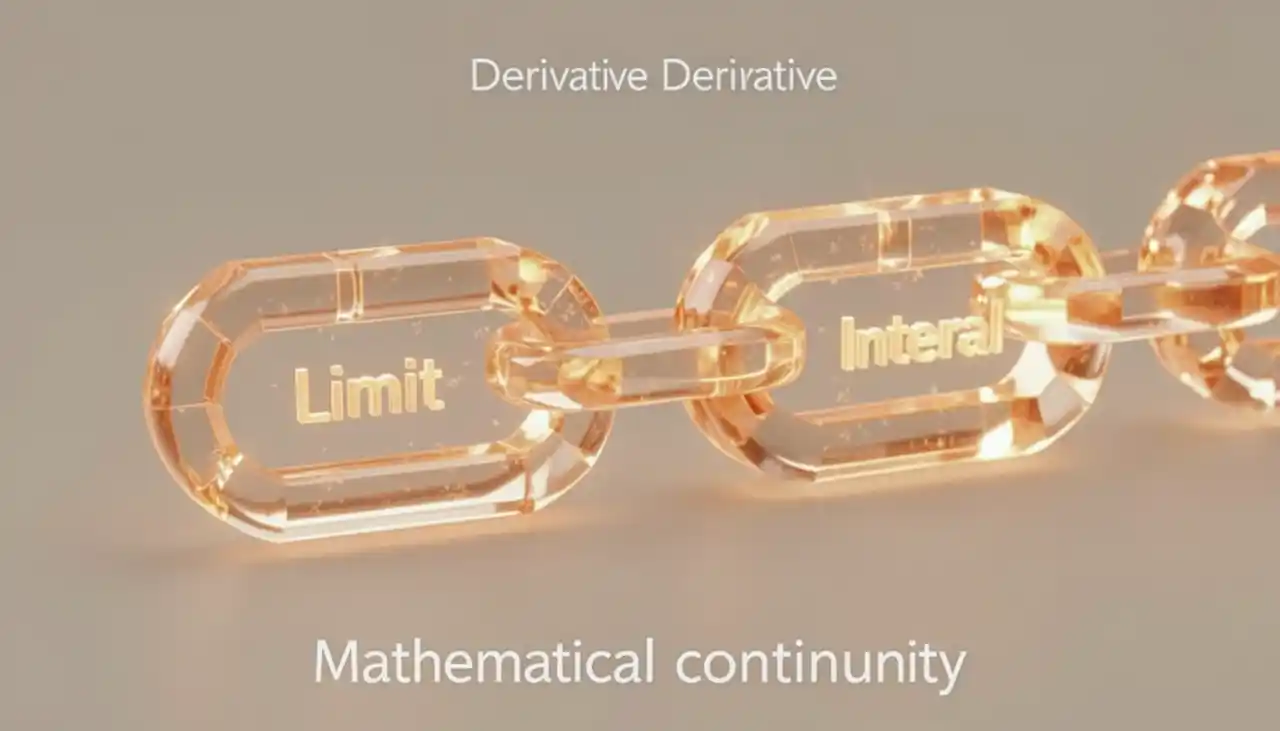
Chain Reaction and Integrity Among LTI
You should not see these three topics as independent islands. The limit defines the derivative ($f'(x) = \lim_{h \to 0} \dots$); the derivative, in turn, is the source of the function inside the integral. Academically, the Fundamental Theorem of Calculus certifies this magnificent bond between integral and derivative. In your study plan, you should handle these topics in a sequential order and not move to the next without fully solidifying the current one. When the 'approach' logic in limits combines with the 'tangent' concept in derivatives and the 'area' concept in integrals, an unshakeable calculus foundation will form in your mind.
Trigonometry and LTI Integration
In AYT mathematics, LTI questions are usually not asked alone but are blended with Trigonometry and Logarithms. Finding the limit of a trigonometric function or taking its derivative requires knowledge of identities in addition to formula mastery. 'Selective' questions in the exam are generally in this interdisciplinary structure. Carving trigonometric derivative and integral rules into your mind like a rhythm will increase your processing speed in complex questions. Mathematics is an order where all sub-branches are locked together; for the student who notices this order, LTI is no longer an obstacle, but an opportunity.
Analytical Geometry and LTI Visualization
Reflections of function graphs on the analytical plane are the visual leg of LTI success. When writing a tangent equation in derivatives, one must use line equation knowledge from analytical geometry; when finding areas in integrals, one must determine intersections of lines and curves. Candidates with advanced Graph Reading skills can often predict the result by looking at the character of the graph instead of long calculation steps. To keep visual intelligence active, you should definitely keep a copy of basic function graphs (parabola, logarithm, trigonometry) at your desk.
Conclusion: High-Level Mathematical Competence
In conclusion, AYT Mathematics, and specifically the LTI group, requires patience and consistent deepening. Learn the topics not just to pass the exam, but to gain a mathematical vision. Watching plenty of 'proof' videos or questioning the reasons behind theorems will increase the permanence of knowledge. Gaining full marks from LTI questions in practice exams will raise not only your math grade but your overall ranking to levels you couldn't imagine. Now take the pen in your hand and start pushing your own limits in this magnificent mathematical adventure.

TYT AYT Mathematics: Topics & Formulas — Experience This Now
Download our app to explore all these features and more.